You asked your cloud provider for a compliance letter last quarter. What came back was a stack of PDFs, a shared responsibility matrix nobody on your team had time to read, and a follow-up question from your biggest prospect: "Can you also send your NIS2 evidence?"
If you sell into the EU, this scenario is now the norm rather than the exception. Enterprise buyers want GDPR, NIS2, SOC 2, and often ISO 27001 evidence before they will even sign a contract, and regulators have made it clear that "my cloud provider handles that" is no longer an acceptable answer. The trap most small and mid-sized teams fall into is building three or four parallel compliance programmes, one per framework, and burning out their engineering staff in the process.
This article takes a different angle: how to meet all four frameworks with one set of infrastructure controls, without over-engineering your stack. We'll cover what changed in 2026, where the frameworks overlap, how the shared responsibility model actually works in practice, and what a lean, defensible compliance architecture looks like.
Key takeaways
- GDPR, NIS2, SOC 2, and ISO 27001 overlap heavily at the infrastructure layer, so one well-built control set can satisfy all four frameworks.
- The shared responsibility model means your cloud provider's certifications cover their layer only; identity, configuration, encryption, backups, and evidence remain yours.
- Data residency is an architecture decision: keep personal data in EU regions, map third-party integrations, and document where each data class lives.
- Auditors in 2026 ask for tested RPO/RTO targets and restore records, not just "do you have backups?"
- A certified, EU-based provider (ISO 27001, SOC 2, GDPR-aligned) removes entire categories of work from your compliance programme.
Table of Contents
- Why Cloud Compliance Is More Complex in 2026 Than It Was in 2023
- The Four Frameworks That Matter Most: GDPR, NIS2, SOC 2, and ISO 27001
- The Shared Responsibility Model: What Your Cloud Provider Covers vs. What You Must Own
- Data Residency and Cross-Border Transfer Rules: How to Architect Around Them
- Practical Infrastructure Controls That Satisfy Multiple Frameworks at Once
- How a Stateful Firewall, WAF, and DDoS Mitigation Layer Map to Framework Requirements
- Automated Backup with Documented RPO/RTO: The Audit Evidence Auditors Actually Want
- How Certified, EU-Based Infrastructure Reduces Your Compliance Burden
- Your 2026 Cloud Compliance Checklist
- The Bottom Line
Why Cloud Compliance Is More Complex in 2026 Than It Was in 2023
Three years ago, most SMEs operating in Europe could get by with a GDPR privacy policy, a SOC 2 report for US enterprise deals, and a general promise that security was "taken seriously." That era is over.
Several forces converged to make 2026 materially harder:
- NIS2 enforcement has teeth. The EU's NIS2 Directive, which expanded the scope of critical infrastructure obligations to thousands of mid-sized companies, has moved from transposition into active supervision. National authorities can now issue binding instructions, demand evidence of risk management measures, and levy fines that reach into the millions for essential entities. Unlike GDPR, NIS2 also carries personal liability: management bodies can be held accountable for failures.
- Buyers demand evidence before contracts. Security questionnaires that once asked "do you have backups?" now ask for your documented RPO and RTO, your DDoS mitigation capacity, and proof of encryption at rest and in transit. Procurement teams have become de facto auditors.
- Frameworks stack. A single mid-market SaaS company selling into European enterprises may now need GDPR compliance (privacy), NIS2 (operational resilience), SOC 2 (US buyer trust), and ISO 27001 (international credibility) simultaneously. Industry analysis of data center and cloud compliance trends in 2026 consistently highlights this stacking effect as the top operational challenge for lean teams.
- AI workloads brought new scrutiny. The EU AI Act's applicability milestones began landing in 2025 and 2026, adding obligations for companies deploying AI systems, which now includes most SaaS products with any machine-learning component.
The result: compliance is no longer an annual project. It is a property of your infrastructure. And that is actually good news, because infrastructure properties can be built once and reused across every framework.
The Four Frameworks That Matter Most: GDPR, NIS2, SOC 2, and ISO 27001
Before you can consolidate, you need to understand what each framework actually demands of your infrastructure, as opposed to your legal or HR processes.
GDPR is fundamentally about personal data. From an infrastructure standpoint, the requirements are data residency awareness (transfers outside the EU need safeguards), encryption, access control, breach detection and notification within 72 hours, and the ability to delete data on request. Most GDPR failures are process failures, but the technical controls live in your infrastructure.
NIS2 is about operational resilience. It requires risk management measures, incident handling and reporting, business continuity planning (including backups and disaster recovery), supply chain security, and basic cyber hygiene like multi-factor authentication and network segmentation. If you read that list and thought "that sounds like a security checklist," you are exactly right.
SOC 2 is an attestation framework built around the Trust Services Criteria: security, availability, processing integrity, confidentiality, and privacy. It is evidence-driven. Auditors want logs, monitoring records, access reviews, and change management documentation. SOC 2 does not prescribe specific technologies; it asks you to prove that the controls you claim are real.
ISO 27001 is a certifiable information security management system (ISMS). It covers risk assessment, asset management, cryptographic controls, communications security, and operational continuity. Unlike SOC 2, it results in a certificate you can put on your website, which is why European buyers often prefer it.
Here is the key insight: these four frameworks overlap enormously at the infrastructure layer. Encryption at rest satisfies GDPR Article 32, NIS2's risk management measures, SOC 2's confidentiality criterion, and ISO 27001's A.8.24 simultaneously. One control, four pieces of evidence. This overlap is the foundation of the "build once, comply many times" approach, which we explored in depth in our guide to building one cloud infrastructure that satisfies GDPR, NIS2, and DORA without running three parallel compliance programmes.
The Shared Responsibility Model: What Your Cloud Provider Covers vs. What You Must Own
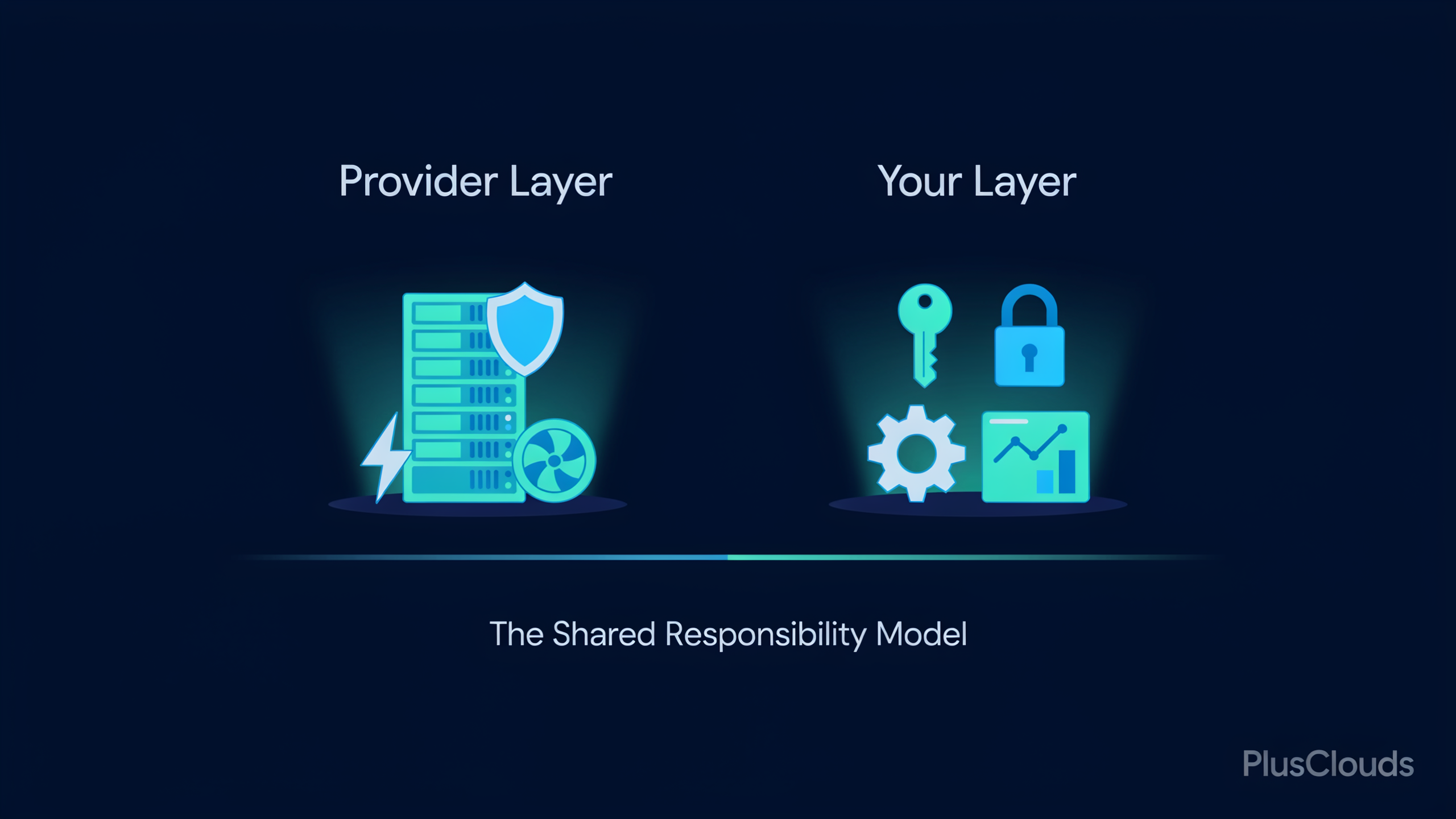
Most compliance failures trace back to a misunderstanding of the shared responsibility model. Teams assume the provider's certifications transfer to them wholesale. They do not.
The model works like this:
| Layer | Provider's Responsibility | Your Responsibility |
|---|---|---|
| Physical security, power, cooling | ✅ Provider | ❌ |
| Hypervisor and network fabric | ✅ Provider | ❌ |
| DDoS mitigation at network level | ✅ Often provider | Verify capacity and coverage |
| OS hardening and patching | ❌ | ✅ You |
| Application configuration | ❌ | ✅ You |
| Data encryption and key management | ❌ | ✅ You |
| Access control and identity | ❌ (provides tooling) | ✅ You |
| Backup configuration and testing | ❌ (provides tooling) | ✅ You |
| Compliance evidence for your own controls | ❌ | ✅ You |
A provider's ISO 27001 certificate covers their infrastructure. It does not cover the fact that you left a database exposed on a public IP or never tested a restore. When an auditor or a prospect asks for your compliance evidence, the provider's certificate is only one exhibit among many.
The practical takeaway: choose a provider whose certified infrastructure eliminates the bottom half of your workload (physical security, network-level protections, certified facilities), then focus your internal effort on the controls only you can own: identity, configuration, data handling, and documentation.
Data Residency and Cross-Border Transfer Rules: How to Architect Around Them
Data residency is where GDPR compliance becomes an infrastructure decision rather than a legal one. Under GDPR, transferring personal data outside the EU requires an appropriate safeguard, typically Standard Contractual Clauses (SCCs) plus a transfer impact assessment. But in 2026, an increasing number of buyers and sector-specific rules simply want the data to stay in the EU, full stop.
Architecting around this is straightforward if you plan for it and painful if you retrofit:
- Pick an EU-region provider with EU-registered legal entities. This keeps the data controller-processor chain clean and simplifies your records of processing activities.
- Separate data tiers. Personal data and processing workloads stay in EU regions. Non-personal workloads (build systems, analytics on aggregated data, staging with synthetic data) can run wherever capacity is cheapest. We covered this tiering approach in our data sovereignty guide on keeping workloads inside national borders without sacrificing performance.
- Watch your dependencies. A US-based SaaS monitoring tool that ingests your EU customer data is a cross-border transfer, even if your servers never leave Frankfurt. Map every third-party integration that touches personal data.
- Document the architecture. A simple network diagram showing where each data class lives is worth more in an audit than fifty pages of policy.
Practical Infrastructure Controls That Satisfy Multiple Frameworks at Once
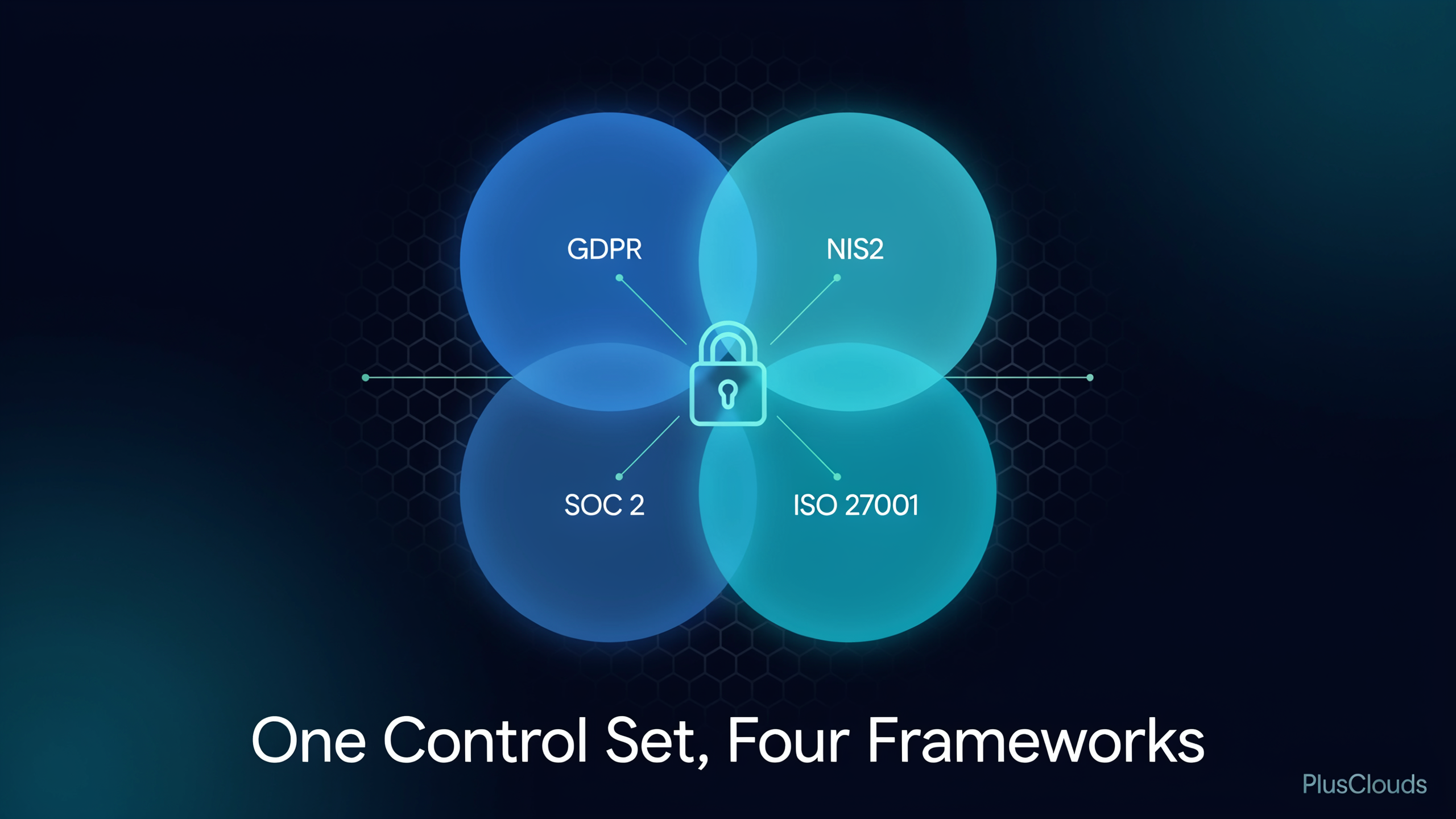
Here is where the consolidation happens. Below are the controls that appear, in some form, in all four frameworks, along with what each framework calls them.
1. Network segmentation. Separate public-facing, internal, management, and database zones. GDPR calls this a security measure under Article 32. NIS2 calls it cyber hygiene. SOC 2 maps it to the security criterion. ISO 27001 maps it to network security controls. If you need a starting design, our guide to segmenting your cloud network into public, private, VPN, DMZ, and management zones walks through a practical topology.
2. Encryption everywhere. TLS 1.2+ in transit, AES-256 at rest, documented key management. One control, four checkboxes.
3. Access control with least privilege. MFA on all administrative access, role-based permissions, and quarterly access reviews. Over-privileged roles are consistently the biggest attack surface in cloud environments, and every framework asks how you manage them.
4. Logging and monitoring. Centralized logs with retention appropriate to each framework (NIS2 incident reporting, SOC 2 evidence, ISO 27001 audit trails). You do not need a SIEM on day one; you need logs you can actually retrieve.
5. Vulnerability and patch management. A documented scanning cadence and patch SLAs. NIS2 explicitly requires this; the others expect it.
6. Backup and recovery. Covered in detail below, because it deserves its own section.
The point is not that compliance is easy. It is that the hard part is shared. Build these six controls once, document them once, and map them to each framework's language in a simple cross-reference spreadsheet. That spreadsheet becomes your audit evidence pack.
How a Stateful Firewall, WAF, and DDoS Mitigation Layer Map to Framework Requirements
Network security is the area where buying the right infrastructure pays the biggest compliance dividend, because a single well-architected security layer satisfies requirements across every framework.
A stateful firewall enforces your segmentation policy and provides the access control evidence that ISO 27001 and SOC 2 auditors ask for. It is also the first thing NIS2 supervisors look for when assessing "appropriate and proportionate technical measures."
A web application firewall (WAF) with OWASP Top 10 coverage protects the application layer, which firewalls alone do not. For any company handling personal data, a WAF is one of the most defensible Article 32 measures you can cite after a breach attempt, because it demonstrates proactive technical protection.
DDoS mitigation maps directly to NIS2's availability requirements and SOC 2's availability criterion. The critical detail is that mitigation must be always-on, not reactive. L7 attacks in particular bypass traditional defences and arrive with no warning; we covered why in our piece on application-layer DDoS and always-on mitigation. An attacker who can take your service offline has, from a regulator's perspective, caused an availability incident you must be able to prevent and report on.
If you are evaluating providers, PlusClouds Cloud Security bundles all three layers: stateful firewall, WAF with OWASP Top 10 coverage, and always-on DDoS mitigation with more than 1 Tbps of capacity, delivered on infrastructure that is itself ISO 27001, SOC 2, and GDPR compliant. That combination means the bottom half of your shared responsibility matrix is largely pre-answered.
Automated Backup with Documented RPO/RTO: The Audit Evidence Auditors Actually Want
Backups deserve special attention because they are the control most teams claim and few can prove.
Every framework asks about backup. But auditors in 2026 do not ask "do you have backups?" They ask:
- What is your Recovery Point Objective (RPO), the maximum acceptable data loss, measured in time?
- What is your Recovery Time Objective (RTO), the maximum acceptable downtime?
- When did you last test a restore, and can you show the test record?
- Are backups encrypted and stored separately from production?
An RPO of four hours with no restore test is worth less than an RPO of eight hours with a documented, successful restore from last month. The evidence is the control.
This matters commercially, too. Enterprise buyers increasingly demand explicit RPO/RTO commitments in security questionnaires, and supervisory authorities under NIS2 and DORA have made recovery testing a focal point of reviews. We broke down exactly what documentation passes in our DORA Article 11 and 12 survival guide on designing, testing, and documenting backup and recovery controls, and the same evidence structure works for NIS2, SOC 2, and ISO 27001.
When choosing tooling, look for three capabilities: scheduled automated backups with defined retention, explicit RPO/RTO targets tracked against an SLA, and remote restore to a clean environment (which doubles as your ransomware recovery story). PlusClouds Automated Backup provides exactly this: automated backup and recovery with explicit RPO/RTO targets, SLA tracking, and remote restore, so the evidence your auditor wants is generated as a byproduct of normal operations rather than assembled manually before each audit.
How Certified, EU-Based Infrastructure Reduces Your Compliance Burden
There is a simple calculation most teams never run: the cost of inheriting compliance from your provider versus building it yourself.
Running your workloads in a data center that is already Tier 3 certified with N+1 redundancy, on infrastructure that already holds ISO 27001 and SOC 2 certifications and is operated under GDPR-aligned processes, removes entire categories of work from your compliance programme. You do not write physical security policies. You do not audit your provider's cooling redundancy. You attach their certificate to your evidence pack and move on.
PlusClouds' data centers operate Tier 3 facilities with N+1 redundancy and a 40 Gbps backbone, and the underlying cloud infrastructure is ISO 27001, SOC 2, and GDPR compliant. For a lean team, this is the difference between a two-person compliance effort and a six-person one. Your auditors still assess your controls, but the facility-level and platform-level questions are answered before they are asked.
The same logic applies to workload placement. If some workloads genuinely cannot leave your building, a hybrid architecture with certified cloud for the elastic tier and certified bare metal for the sensitive tier lets you keep one compliance narrative across both. Our hybrid infrastructure playbook for growing SaaS teams covers how to run that split from a single control plane.
One side note for teams that also sell B2B: compliance obligations extend to your marketing and sales data processing too. If you run AI-powered prospecting, our guide to GDPR-compliant AI outreach with LeadOcean and Eaglet in Europe covers how to keep your lead generation activities on the right side of the same regulators.
Your 2026 Cloud Compliance Checklist
Here is the consolidated cloud security compliance checklist, built from the shared-controls approach above. Print it, assign owners, and work through it top to bottom.
Foundation (week 1-2)
- Confirm your provider's certifications (ISO 27001, SOC 2, GDPR processes) and obtain current certificates and shared responsibility documentation
- Map where each class of data lives, including third-party integrations
- Document your architecture in a simple network diagram
Network and access controls (week 2-4)
- Deploy or verify a stateful firewall with documented rules
- Deploy a WAF with OWASP Top 10 coverage on all public-facing applications
- Verify always-on DDoS mitigation and its capacity
- Segment networks into public, private, management, and DMZ zones
- Enforce MFA on all administrative access and review roles for least privilege
Data protection (week 3-5)
- Enable encryption in transit (TLS 1.2+) and at rest (AES-256)
- Document key management
- Configure automated backups with explicit RPO/RTO targets
- Perform and document a full restore test
Operations and evidence (week 4-8)
- Centralize logs and define retention periods
- Establish a vulnerability scanning and patching cadence with SLAs
- Build the cross-reference spreadsheet mapping each control to GDPR, NIS2, SOC 2, and ISO 27001 requirements
- Write and rehearse an incident response plan with the 72-hour GDPR notification clock in mind
- Schedule quarterly access reviews and annual restore tests
If you can tick every box on that list, you have infrastructure evidence that satisfies all four frameworks from a single build, and you have not hired a single additional compliance engineer to do it.
The Bottom Line
Compliance in 2026 is not four separate projects. It is one well-architected infrastructure, documented once and translated four times. The teams that struggle are the ones that treat each framework as a separate initiative; the teams that succeed pick a provider whose certified, secure-by-default infrastructure eliminates the controls they should never have owned in the first place, then focus their energy on identity, configuration, and evidence.
If you are evaluating where to run those workloads, PlusClouds' cloud platform combines certified ISO 27001 / SOC 2 / GDPR-compliant infrastructure, an integrated Cloud Security layer, automated backup with documented RPO/RTO targets, and Tier 3 data centers in a single platform, so most of your checklist is pre-answered on day one. Take a look at PlusClouds Cloud Servers to see how quickly you can stand up a compliant foundation, and start your 2026 compliance programme from a base you did not have to build yourself.