Your SDR team just booked 40 meetings in a month using an AI prospecting stack. Pipeline is up. Your CRO is happy. Then a prospect in Munich emails back, not with interest, but with a copy of your outreach email forwarded to a data protection lawyer, asking under which legal basis you processed his personal data. Nobody on the revenue team has an answer.
That scenario is not hypothetical. Roughly 89% of revenue organizations now use AI somewhere in their sales motion, according to 2026 industry surveys (Talent Bridge, Autobound), and most of those teams in Europe are running that AI against personal data governed by the GDPR. Enforcement is not theoretical either: supervisory authorities across the EU have issued fines for unlawful direct marketing processing, and national courts (notably in Germany) have repeatedly confirmed that B2B cold outreach is not a legal free zone just because the recipient wears a business hat.
This guide walks through the actual legal mechanics of running AI-powered outbound in Europe: which legal basis covers cold B2B email, what data you can lawfully process, how to configure LeadOcean and Eaglet so your sequences carry opt-outs and audit trails, where your data physically lives, and a pre-campaign checklist you can hand to your DPO.
Key takeaways
- GDPR compliant B2B outreach in Europe generally runs on legitimate interest (Article 6, Recital 47), documented in a Legitimate Interest Assessment before the first email is sent. Consent does not work for cold outreach.
- There is no B2B exemption in the GDPR. A business email address tied to a named person is personal data, and AI enrichment of that data counts as profiling.
- Professional-context contact data from accountable sources is defensible; scraped personal social profiles and untraceable data broker records are not.
- Eaglet sequences must carry an opt-out in every message, honor objections immediately across all sequences, and preserve audit trails for supervisory authority requests.
- Hosting your CRM, enrichment, and outreach stack on EU-based infrastructure keeps prospect data inside the EEA and minimizes Chapter V transfer exposure.
Table of Contents
- Why GDPR Is the Biggest Hidden Risk in AI-Powered B2B Outreach, and Why Most Teams Ignore It
- Legitimate Interest vs. Consent: Which Legal Basis Actually Covers Cold B2B Outreach?
- What Data You Can and Cannot Use: Publicly Available Professional Data vs. Scraped Personal Data
- How LeadOcean Sources and Verifies Contact Data in a GDPR-Compatible Way
- Configuring Eaglet Sequences to Include Mandatory Opt-Out and Audit Trails
- Keeping Prospect Data Within EU Infrastructure: Why Your CRM and Enrichment Stack Matter
- Response Rate vs. Risk: Why Compliant Outreach Actually Performs Better
- A Pre-Campaign GDPR Checklist for LeadOcean + Eaglet Users
- The Bottom Line
Why GDPR Is the Biggest Hidden Risk in AI-Powered B2B Outreach, and Why Most Teams Ignore It
The GDPR applies to any processing of personal data. A business email address attached to a named person, [email protected], is personal data. Full stop. There is no "B2B exemption" in the regulation, despite how often that myth gets repeated in sales Slack channels.
What actually trips teams up is the gap between tooling speed and legal process. AI prospecting tools can identify, enrich, and sequence thousands of contacts in an afternoon. Your legal review process takes weeks. So the temptation is to run first and justify later. That inversion is exactly what supervisory authorities look for when they investigate: processing that started without a documented lawful basis, no record of where the data came from, and no evidence the data subject was ever informed.
The financial exposure is real. GDPR fines scale up to 4% of global annual turnover or €20 million, whichever is higher, for the most serious violations. But the more common outcome for outbound-related complaints is smaller administrative fines plus corrective orders, which still mean pausing campaigns, producing documentation under deadline, and explaining yourself to a regulator. For a mid-market company, the operational disruption often hurts more than the fine.
There is a second, quieter risk: AI enrichment itself. When you feed a prospect list into an AI matching engine, you are processing personal data (profiling, in GDPR terms). Article 22 restricts solely automated decisions with legal or similarly significant effects, and Article 13 requires you to disclose automated processing in your privacy notices. Most sales teams have never updated their privacy policy to reflect any of this.
The teams that ignore GDPR do not usually get caught tomorrow. They get caught in the worst possible moment: during a due-diligence review before an acquisition, an enterprise security questionnaire, or a complaint from one motivated prospect.
Legitimate Interest vs. Consent: Which Legal Basis Actually Covers Cold B2B Outreach?
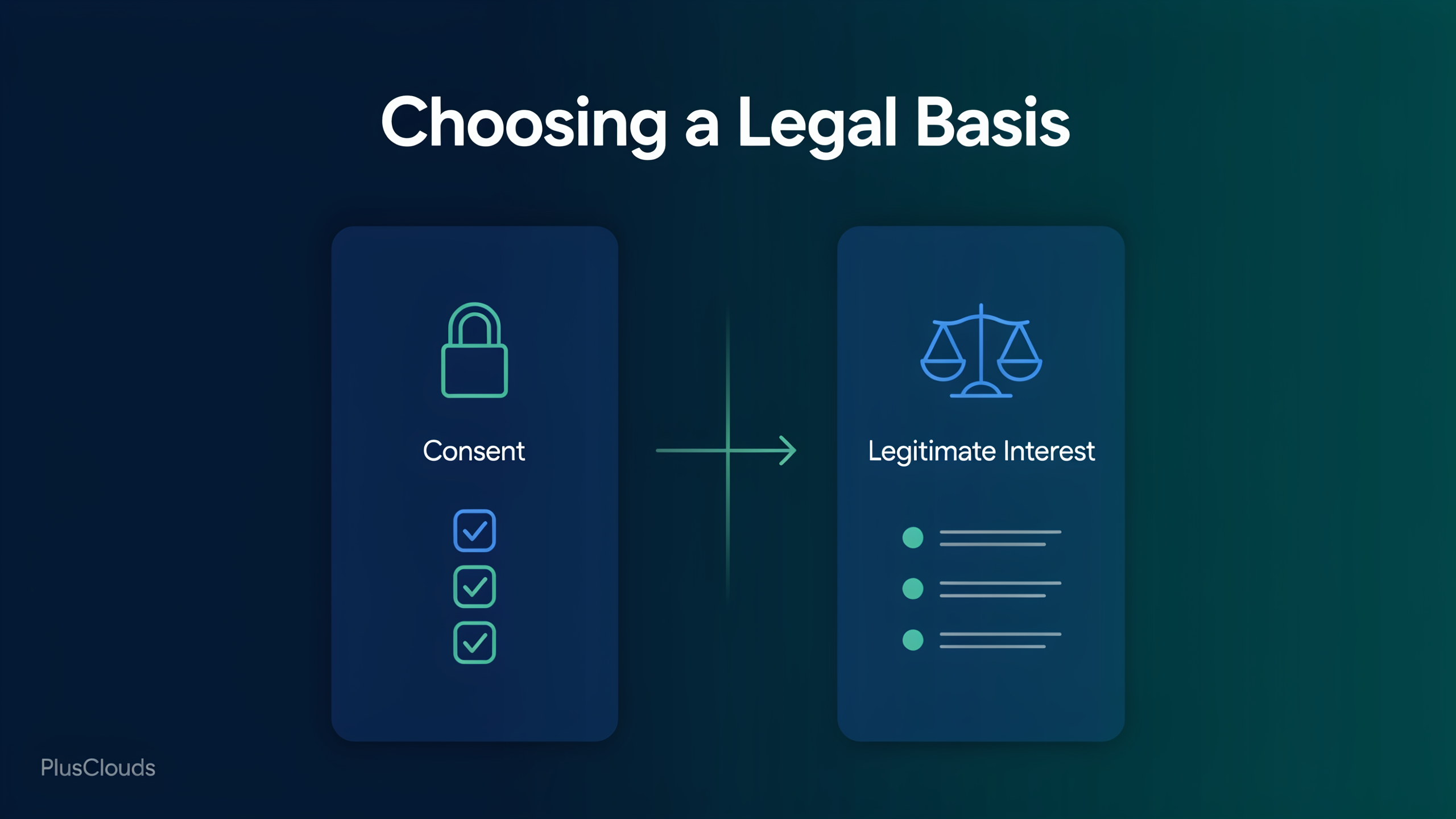
You have six possible legal bases under Article 6. For outbound B2B prospecting, two are contenders: consent and legitimate interest.
Consent is a non-starter for cold outreach, almost by definition. Consent must be freely given, specific, informed, and unilateral. You cannot ask someone for permission to email them before you have ever contacted them, and pre-checked boxes or implied consent do not qualify. If your legal basis is consent, you can only email people who have actively opted in. That is inbound marketing, not outbound.
Legitimate interest is the basis nearly every serious European B2B outbound operation runs on, and it is explicitly recognized in Recital 47 as potentially valid for direct marketing. But legitimate interest is not a checkbox. It requires a three-part balancing test, documented in a Legitimate Interest Assessment (LIA):
- Purpose test. Is your interest real and lawful? Selling B2B software and services qualifies. The purpose must also be transparent to the data subject.
- Necessity test. Is processing this specific personal data necessary for that purpose? Emailing a professional address to pitch a relevant business product is generally considered necessary; scraping someone's private social activity to build a psychological profile is not.
- Balance test. Does the individual's interest override yours? This is where B2B has its strongest argument: the data subject is a professional acting in a business role, the outreach concerns their professional function, and the intrusion is limited to a work inbox.
The European Data Protection Board and national regulators have consistently distinguished B2B from B2C here. Cold email to consumers under PECR-style e-privacy rules requires opt-in consent in most member states. Cold email to a professional about a product relevant to their role, sent in a business context, can rest on legitimate interest if you do the assessment and honor the safeguards: a clear opt-out in every message, honoring opt-outs immediately, and informing people where their data came from.
Two practical notes. First, e-privacy rules (the ePrivacy Directive, implemented nationally) sit on top of the GDPR and vary by member state. Germany, Austria, and Italy are stricter on unsolicited electronic marketing than, say, the Netherlands. If you run pan-EU campaigns, your LIA should note the strictest applicable standard. Second, document the LIA before the first email goes out, not after. A retroactive assessment is evidence of a violation, not a defense.
What Data You Can and Cannot Use: Publicly Available Professional Data vs. Scraped Personal Data
"Publicly available" does not mean "free to use however you like." The GDPR governs processing, not just collection, so a person's name on a public website is still protected the moment you copy it into your CRM.
The workable distinction for B2B prospecting is between professional data disclosed for business purposes and personal data scraped from contexts that had nothing to do with business outreach.
Generally defensible sources:
- Company websites listing employees and their roles, published specifically so business counterparts can reach them
- Professional directories, registries, and trade publications
- Business contact databases whose providers operate as GDPR-compliant processors with documented sourcing and opt-out mechanisms
- First-party data: your own website visitors, event attendees, and inbound leads, processed under their own consent records
Sources that create real problems:
- Personal social media profiles scraped against platform terms of service. Several supervisory authorities have taken positions against this, and the platform itself may pursue you separately.
- Private contact details (personal mobile numbers, personal email addresses) used for business outreach without a separate basis
- Enrichment from data brokers who cannot tell you where their records came from. If your vendor cannot answer the sourcing question, the liability does not disappear. It transfers to you, because you are the controller.
Under Article 5, you also owe data minimization and accuracy. That means you should not hoard every field a scraper can find, and you should verify that the decision-maker you are emailing actually holds the role you think they hold. Stale data is not just embarrassing; emailing a person who left the company two years ago is processing personal data about someone who has no connection to your purpose at all.
This is the point where sourcing quality stops being a data-quality issue and becomes a compliance issue. When LeadOcean builds a contact record, it searches across more than 1.8 billion company data points and resolves verified decision-maker contacts tied to professional roles, rather than aggregating whatever personal footprint it can find. For a compliance review, that distinction matters: you can explain to a supervisory authority why you believed a given professional email address was appropriate to process. You cannot explain a scraped personal Instagram handle.
How LeadOcean Sources and Verifies Contact Data in a GDPR-Compatible Way
Let us be precise about what a controller needs from a lead data tool, because this is where vendor selection becomes a legal decision.
Your obligations as controller do not transfer to the vendor. But Article 28 requires a data processing agreement with any processor handling personal data on your behalf, and the practical quality of that relationship determines how much risk you carry.
When you evaluate how LeadOcean fits into a GDPR-compliant workflow, four capabilities do the heavy lifting:
- Professional-context sourcing. Contacts are resolved from business and company data, meaning the data subject's professional role is the reason the record exists. That aligns directly with the necessity and balance legs of your LIA.
- Verification before delivery. The AI Match Engine scores and validates contacts against your Ideal Customer Profile before they reach you, which serves data minimization: you are not importing 50,000 raw records, you are importing the ranked subset relevant to your purpose. (If you are still shaping that ICP, our guide to firmographic filters, buying signals, and AI matching covers the targeting layer in depth.)
- Suppression and exclusion. A compliant workflow needs a way to exclude opted-out contacts, competitors, and existing customers from every export. Build your suppression list into the tool workflow, not into a spreadsheet someone updates quarterly.
- CRM integration with provenance. The HubSpot and Salesforce integrations carry contact records into your CRM with their source context intact, which is exactly what you need when a DPO asks "where did this record come from?" six months later.
Get the data processing agreement signed, document the sourcing model in your Record of Processing Activities (Article 30), and your lead data foundation is defensible. The next risk point is what you do with those records once they are in a sequence.
Configuring Eaglet Sequences to Include Mandatory Opt-Out and Audit Trails
Eaglet is the outreach execution layer, and it is also where most compliance failures happen in practice, because execution is where transparency obligations become visible to the data subject.
Three configuration requirements, in order of legal importance:
1. Opt-out in every message, honored immediately. Article 21 gives data subjects an unconditional right to object to direct marketing, and once they object, you must stop processing their data for that purpose. Configure Eaglet so that an opt-out reply or link click removes the contact from all active sequences across the workspace, not just the current campaign. Test this quarterly with a real test contact. An opt-out that takes three days to propagate because of a sync lag is a violation in progress.
2. Transparent sender identity and honest framing. Recital 42 and the fairness principle (Article 5) require that the data subject is not deceived. Your sequences should identify your company accurately, use a reply-able mailbox, and state or link to why the recipient is receiving the message. Eaglet's personalization pulls from professional and buying-signal context, which is fine; fabricating a false "we met at" premise is not.
3. Audit trails. When a supervisory authority asks, you need to show: when this contact entered your system, from what source, what was sent, when, and what happened at the opt-out. Eaglet's CRM sync preserves the sequence history against each contact record, which turns a stressful information request into a query. Keep suppression lists and campaign definitions for as long as you run outreach to that contact, and purge data that no longer serves a purpose under your retention policy.
One more practical layer: if you use AI to draft sequence copy, keep a human review step before launch. AI-generated outreach that misstates facts about the prospect's company is an accuracy problem under Article 5, and it is also a reply-rate problem.
For the sequence architecture itself, including how email, LinkedIn, and phone steps coordinate, our omnichannel outreach guide covers the mechanics; the compliance layer described here sits underneath every channel in that stack.
Keeping Prospect Data Within EU Infrastructure: Why Your CRM and Enrichment Stack Matter
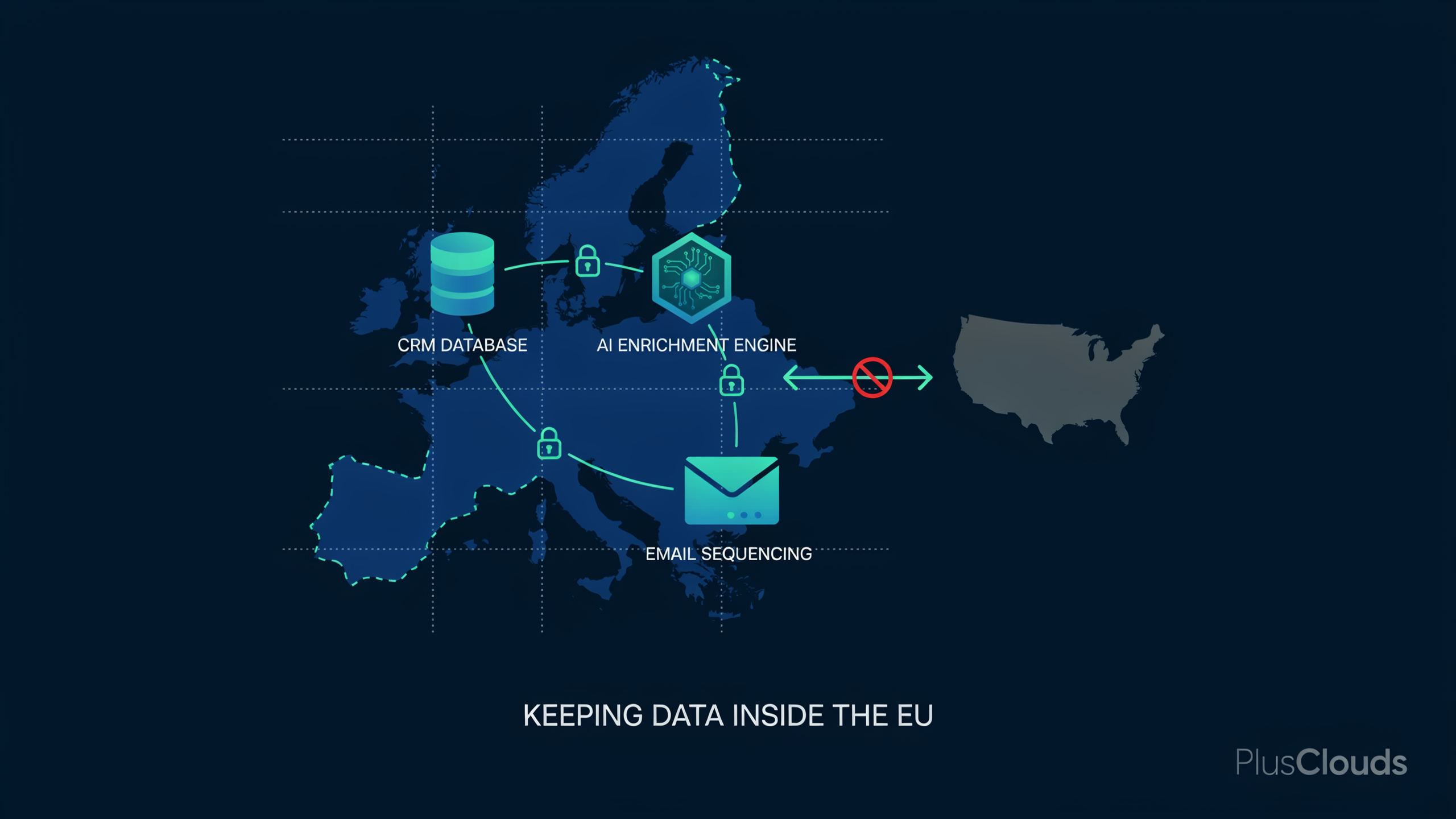
Data location is not a compliance formality. Chapter V of the GDPR restricts transfers of personal data outside the EU/EEA, and since the 2020 Schrems II ruling, transfers to the United States (and other third countries) require a valid transfer mechanism such as standard contractual clauses plus a documented transfer impact assessment.
Most B2B teams fail here without noticing. Your prospect list is in a US-headquartered CRM. Your enrichment tool processes it on US cloud infrastructure. Your email sequencing platform stores engagement data on US servers. Each of those is a transfer, and each needs its own mechanism and documentation. The paperwork is manageable, but the transfer impact assessments pile up, and any change in the vendor's infrastructure footprint can invalidate them.
The simpler architecture is to keep the processing inside the EU/EEA in the first place. Where your stack runs on infrastructure you control, hosting the CRM, enrichment workloads, and outreach tooling on EU-based Cloud Servers keeps the personal data within EEA borders by default and shrinks your Chapter V exposure to near zero. PlusClouds cloud servers deploy in about 60 seconds on AMD EPYC hardware with NVMe storage, carry a 99.98% uptime SLA, and charge zero egress fees, which matters when your outreach stack is constantly syncing contact data between systems. Our article on data sovereignty in 2026 covers the broader infrastructure decision.
A few concrete hardening steps for the infrastructure layer:
- Restrict database and CRM access with role-based permissions and MFA; prospect data in a shared spreadsheet with open link access is a breach waiting to happen
- Encrypt prospect data at rest and in transit
- Log access to the prospect database so you can answer "who viewed this data and when"
- Back up the CRM and sequence data on a defined schedule with explicit recovery objectives; our automated backup service lets you set explicit RPO and RTO targets per workload, and Article 32's security-of-processing requirement expects exactly this kind of recoverability discipline
Article 32 security does not require enterprise-grade zero trust for a contact database, but it does require that your security measures are proportionate to the data. Prospect contact data is lower sensitivity than health records, and a proportionate setup is well within reach of any team.
Response Rate vs. Risk: Why Compliant Outreach Actually Performs Better
The compliance conversation usually frames GDPR as friction against performance. The data from teams running disciplined outbound says the opposite, and the reasons are mechanical rather than moral.
Relevance is the compliance requirement and the performance requirement at the same time. The necessity leg of your LIA forces you to only contact people for whom your offer is plausibly relevant in their professional role. That same constraint is what drives reply rates. Teams running signal-based, tightly targeted sequences see materially higher engagement than spray-and-pray volume senders; our breakdown of signal-first outbound documents reply rates in the 18% range for well-targeted sequences, versus low single digits for generic volume campaigns. 2026 industry research points the same direction, with AI-enabled personalization lifting engagement precisely because it narrows targeting (Mutiny).
Deliverability punishes non-compliant behavior too. High-volume sending to scraped or unverified addresses burns sender reputation, triggers spam-folder placement, and gets domains blocklisted. Verified contacts, low bounce rates, and immediate opt-out honoring are the same behaviors that mailbox providers reward. Your compliance configuration and your deliverability configuration are largely the same list.
Enterprise buyers check. If you sell into mid-market and enterprise accounts, procurement and security reviews increasingly include data protection questions about your own vendors. Being able to answer "how do you source and process prospect data?" with a documented LIA, a signed DPA, and EU-based hosting is a sales asset in those deals, not just a legal shield.
Clean data compounds. Data minimization and accuracy requirements push you toward smaller, verified, current lists. Those lists convert better, produce cleaner CRM analytics, and waste less SDR time on dead contacts. The non-compliant alternative, hoarding scraped data that decays at 25-30% per year, produces the opposite.
A Pre-Campaign GDPR Checklist for LeadOcean + Eaglet Users
Before your next campaign launches, work through this list. If you cannot check an item, that item is your gap.
- Legal basis documented. A written Legitimate Interest Assessment covering purpose, necessity, and balancing, dated before campaign launch, reviewed by legal or your DPO.
- DPA signed with every processor. LeadOcean, Eaglet, your CRM, your email infrastructure, and any enrichment vendors.
- Sourcing verified. You can articulate, per contact source, why the data is professional-context data appropriate for B2B outreach.
- Privacy notice updated. Your website privacy policy describes B2B outreach processing, the legitimate interest basis, data sources, retention, and the opt-out route.
- Opt-out mechanism tested. An end-to-end test: reply "unsubscribe" to a test sequence and confirm removal from all sequences and suppression across the workspace.
- Suppression list loaded. Opt-outs, competitors, existing customers, and any contacts under objection are excluded from every export and sequence.
- Data location mapped. You know every system that stores or processes prospect data and where it physically runs; transfers outside the EEA have documented transfer mechanisms.
- Retention policy defined. You know how long unresponsive contacts stay in your database, and a purge job (manual or automated) actually runs.
- Audit trail confirmed. For any contact, you can reconstruct source, consent/opt-out status, messages sent, and timestamps within minutes.
- Human review on AI content. AI-drafted sequence copy is reviewed by a person before launch for accuracy and honest framing.
Items 1 through 5 are the ones a supervisory authority will ask about first. Items 6 through 10 are the ones that keep the answers short.
The Bottom Line
GDPR-compliant AI outreach is not a compromise between scale and legality; it is a specific operating discipline: legitimate interest documented before launch, professional-context data from accountable sources, transparent sequences with immediate opt-out handling, and prospect data kept on infrastructure you control inside the EEA. Teams that build this discipline get better reply rates and cleaner pipeline as a side effect.
If you are standing up this stack, LeadOcean gives you verified, professional-context decision-maker contacts with an auditable sourcing trail, and Eaglet executes sequences with the opt-out and CRM-sync controls the checklist requires. Deploy them on PlusClouds EU-based cloud servers and your prospect data stays inside European borders from the first sync. If you want to see how this architecture maps onto your current setup, start a conversation with our team.