Your CRM knows things about your pipeline that no data vendor does. It knows which accounts stalled at pricing, which champions changed jobs, which industries closed fastest last quarter. Your website knows which of those accounts came back yesterday and spent eleven minutes on your integration docs. Yet in most B2B orgs, these two systems never talk. Prospecting runs on purchased third-party intent feeds while the richest signal library you own sits idle in a Salesforce instance.
Key takeaways
- First-party data from your CRM, website, email, and events is now the top-ranked differentiator in B2B lead generation, and it is exclusive to you in a way no third-party intent feed can be.
- Third-party intent data is declining because cookie deprecation and AI search shrink the trackable web, weakening both coverage and attribution.
- Feed outcome-labelled CRM history into LeadOcean's AI Match Engine to generate lookalike ICP targets, then layer live first-party intent signals on top.
- Sync through HubSpot or Salesforce with asymmetric two-way rules, domain-keyed matching, and nightly outcome updates.
- Activate enriched leads with Eaglet's signal-triggered sequences, score signals for recency, specificity, and outcome correlation, and keep the whole loop inside GDPR boundaries.
That gap is expensive, and it is widening. Third-party intent data is getting harder to buy, harder to trust, and harder to activate as cookies disappear and AI search keeps buyers inside answer engines longer. First-party data, the records you generate from your own CRM, website, email, and events, is now the top competitive differentiator in B2B lead generation according to multiple 2026 industry surveys (Leadfeeder's 2026 trends research and Leadinfo's channel analysis both rank it first).
This guide shows you how to turn that owned data into a prospecting engine: how to map your first-party sources, feed them into LeadOcean's AI Match Engine, sync everything back through HubSpot or Salesforce, activate enriched leads with Eaglet sequences, and close the loop from anonymous visitor to booked meeting without leaving GDPR behind.
Table of Contents
- Why Third-Party Intent Data Is Declining, and What First-Party Data Can Do That It Cannot
- Mapping Your First-Party Data Sources: CRM History, Website Behaviour, Email Engagement, and Event Attendance
- How to Feed First-Party Signals Into LeadOcean's AI Match Engine to Sharpen ICP Targeting
- Connecting HubSpot or Salesforce to LeadOcean: Sync Architecture and Field-Mapping Best Practices
- Using Eaglet to Activate First-Party Enriched Leads With Hyper-Personalised Sequences
- Measuring Signal Quality: How to Score and Validate First-Party Intent Signals Before They Hit Your Sequence
- Compliance by Design: How to Run First-Party Enrichment Within GDPR Boundaries
- Building the Closed-Loop: From Anonymous Visitor to Verified Decision-Maker in One Automated Workflow
Why Third-Party Intent Data Is Declining, and What First-Party Data Can Do That It Cannot
Third-party intent data had a good run. Vendors aggregated cookie-level browsing behaviour across thousands of publisher sites, inferred that an account was "researching Kubernetes," and sold you that inference. It worked when third-party cookies were ubiquitous and buyers did their research across open vendor content.
Both conditions are gone. Safari and Firefox block third-party cookies by default, Chrome's deprecation has reshaped tracking economics even with its delayed timeline, and AI-driven search keeps a growing share of B2B research inside answer engines where publishers cannot tag visitors at all. Gartner's B2B buying research consistently shows that buying groups spend only about 17% of their journey meeting with suppliers, which means the majority of signal generation now happens in places third-party trackers cannot reliably reach.
Here is what changed structurally:
- Coverage shrank. Fewer trackable pages means thinner co-occurrence data, which means intent topics get noisier and more generic.
- Attribution got weaker. Third-party scores tell you an account is "in market" but not what it looked at on your site, which is the part that predicts a reply.
- Everyone buys the same feed. When your competitor subscribes to the same intent vendor, the signal stops being an edge and becomes table stakes.
First-party data inverts every one of those problems. It is exclusive to you, it reflects behaviour on your own properties, and it degrades far more slowly because it does not depend on cross-site tracking. A pricing-page visit from an account that already has two closed-won deals in your CRM is a signal no vendor can sell you. The trade-off is that first-party data is sparse and unstructured by default, which is exactly the problem B2B data enrichment solves, and exactly what the rest of this article is about.
Mapping Your First-Party Data Sources: CRM History, Website Behaviour, Email Engagement, and Event Attendance
Before you wire anything into an AI engine, inventory what you actually hold. Most B2B teams are surprised by the count. There are four source categories of first-party intent signals that matter for prospecting.
CRM history (HubSpot, Salesforce, or equivalent). This is your highest-value source because it carries outcome labels. Closed-won and closed-lost records tell your matching engine what a good customer looks like in firmographic terms: industry codes, employee bands, tech stack fields, deal cycle length, ACV. Churn records tell it what to avoid. A CRM with three years of deal history is a trained model waiting to be queried.
Website behaviour. Page-level visit data resolved to company level via IP identification (website visitor identification for sales). The pages matter more than the visit count. Pricing, security documentation, integration pages, and comparison content are high-intent surfaces; blog posts are top-of-funnel. If you want the deep workflow on visitor identification specifically, we covered it in our first-party intent stack guide.
Email engagement. Opens are nearly meaningless post-Apple Mail Privacy Protection. Replies, link clicks, and repeat visits to links inside your sequences are the durable signals. Track them per contact, not per campaign.
Event attendance. Webinar registrations and attendance duration, trade-show badge scans, and demo requests. Event data is underweighted in most scoring models despite being among the strongest buying signals available, because someone who sat through 42 minutes of your product webinar has self-qualified more honestly than any algorithm could.
Map each source to three attributes before integration: what entity it describes (account or contact), what timestamp it carries, and what direction it implies (positive or negative signal). That last one matters. A support ticket escalation is first-party data too, and feeding it into a prospecting engine without a polarity label will make your targeting worse, not better.
How to Feed First-Party Signals Into LeadOcean's AI Match Engine to Sharpen ICP Targeting
An ICP (Ideal Customer Profile) defined in a spreadsheet is a hypothesis. An ICP learned from your closed-won history is evidence. The point of feeding first-party data into an AI matching engine is to make that swap.
The workflow looks like this:
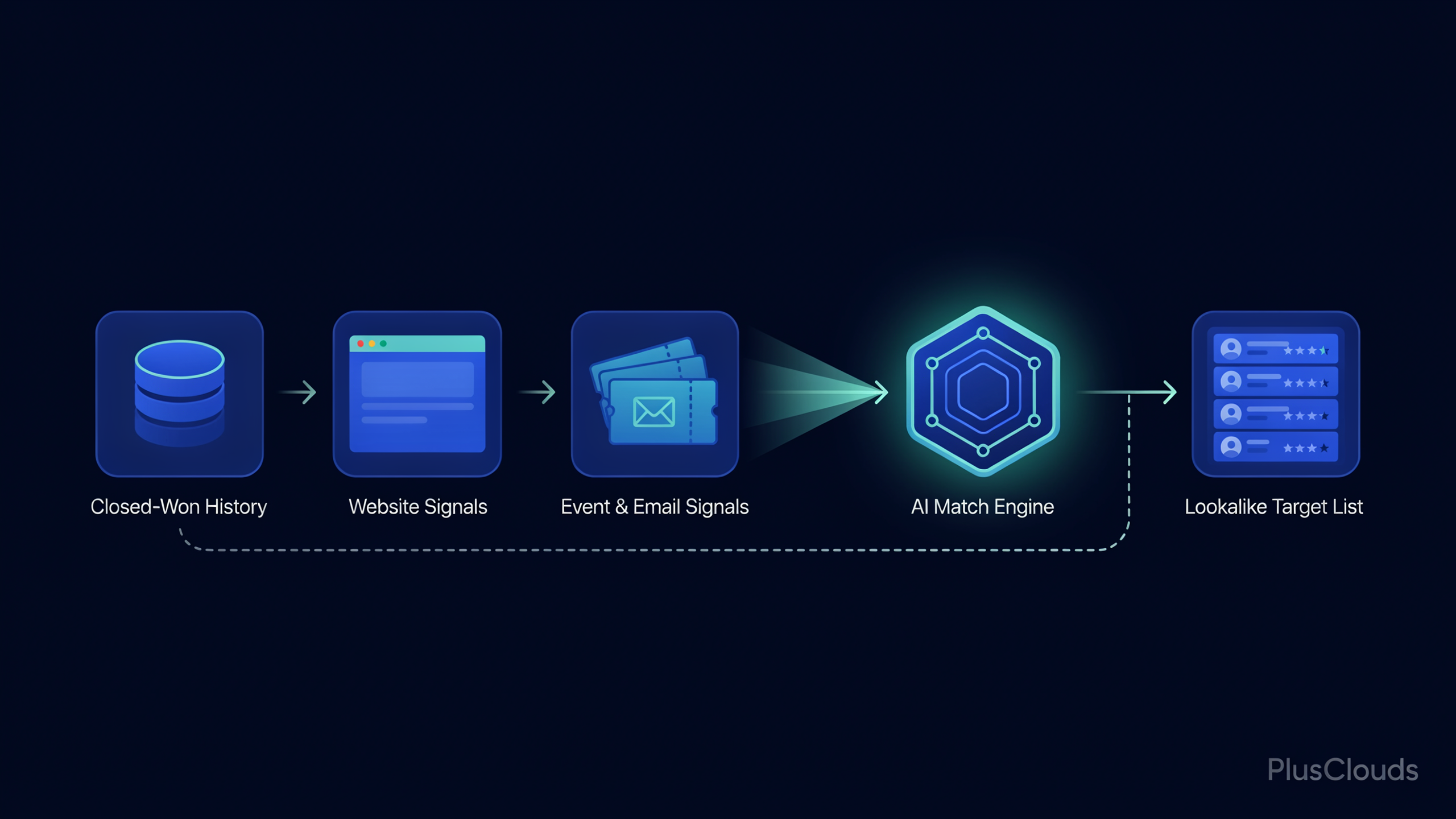
- Export your outcome-labelled account set. Pull every account with a closed-won or closed-lost deal from the last 24 to 36 months, with firmographics attached. Aim for at least 100 accounts per label; below that, treat the output as directional.
- Attach behavioural context. For each account, join the website, email, and event signals from your mapping exercise. You are building a table where each row is an account and each column is a signal with a timestamp.
- Seed the match engine. LeadOcean's AI Match Engine uses this seed set to find lookalike companies across its database of over 1.8 billion company records. Because the seed set is built from your own outcomes rather than a hand-written firmographic filter, the matches inherit patterns you would never have articulated manually, like "mid-market logistics companies that added a data engineering hire within 90 days of their last funding round."
- Layer live first-party signals on top. The engine's buying-signal detection then flags which of those matched accounts are currently showing behaviour consistent with active evaluation, either on your own properties or through the signal types the platform tracks.
The difference from a standard filter-based search is compounding. Every quarter you refresh the seed set with new closed deals, and the match quality improves. If you want to take the scoring logic further and build a prioritisation model your whole revenue team trusts, our guide to building a CRM-native lead scoring engine covers the mechanics in depth.
Connecting HubSpot or Salesforce to LeadOcean: Sync Architecture and Field-Mapping Best Practices
This is where most CRM enrichment integrations go wrong, so it deserves specificity. The native LeadOcean integration supports both HubSpot and Salesforce, and the architecture question is always the same: what flows in which direction, and how often.
Direction of flow. Run a two-way sync but with asymmetric rules. LeadOcean pushes new matched accounts and verified decision-maker contacts into your CRM as companies and contacts, tagged with source and signal metadata. Your CRM pushes back outcome data (deal stage changes, disqualifications) so the match engine's seed set stays current. Never let raw LeadOcean records overwrite CRM records that a rep has manually qualified; use a merge-on-match rule keyed on website domain and company name fuzzy match.
Field mapping. Keep it minimal and named consistently:
| LeadOcean field | CRM object | Sync rule |
|---|---|---|
| Company domain | Account Website |
Primary match key, never overwrite |
| Decision-maker contact | Contact Email, Role |
Create only if no existing match |
| Detected buying signal | Custom property / field | Append with timestamp, do not overwrite |
| Match score | Custom numeric property | Overwrite on each sync, latest wins |
| Source tag | Custom property | Static value, set at creation |
Sync cadence. Push CRM outcome changes to the match engine nightly. Push new matched leads into the CRM in near-real-time or on an hourly cycle, because signal freshness decays fast; our 48-hour activation window analysis shows why a lead that sits for two days is worth a fraction of one worked the same morning.
Deduplication discipline. Before your first sync, run a dedupe pass on both sides keyed on email domain. Duplicate accounts fragment signal history, and a fragmented history makes the match engine learn from half-truths.
Using Eaglet to Activate First-Party Enriched Leads With Hyper-Personalised Sequences
Enriched data is only worth what your outreach does with it. This is where Eaglet enters the workflow, as the activation layer that turns a scored, enriched lead record into a sequence a human would actually reply to.
The mechanics: once a LeadOcean match lands in your CRM with its first-party signal history attached, Eaglet triggers a sequence based on the signal type, not on a static timer. A pricing-page visitor gets a different opening email than a webinar attendee, and both get something different from a cold matched account with no behavioural history.
What "hyper-personalised" means in practice, concretely:
- Reference the signal, not the company name. "I saw your team spent time on our SSO documentation last week" outperforms "I saw {Company} is in {Industry}" every time, because it proves you were paying attention to them.
- Match the ask to the signal temperature. Hot signals justify a direct meeting ask. Warm signals get a relevant asset. Cold matched accounts get a pattern-interrupt opener with no ask at all.
- Route by first-party history. If the CRM shows a previous closed-lost deal with this account, suppress the standard sequence and route to a win-back track instead.
Eaglet syncs replies and engagement data back into the CRM automatically, which closes the loop that feeds the next match-engine refresh. For teams running coordinated email, LinkedIn, and phone touches, our omnichannel outreach engine guide details the multi-channel wiring.
Measuring Signal Quality: How to Score and Validate First-Party Intent Signals Before They Hit Your Sequence
Not all first-party data deserves equal weight, and unvalidated signals will poison your sequences faster than no signals at all. Score every source on four dimensions before it enters the activation layer.
Recency. A signal older than 30 days is context, not a trigger. Weight decays roughly linearly; a pricing visit from 8 days ago is worth several times one from 28 days ago.
Specificity. Rank signals by how uniquely they indicate buying intent. A demo request outranks a pricing-page visit, which outranks a blog visit. Our B2B intent data explainer breaks down this hierarchy in detail.
Volume independence. One account admin accidentally triggering 40 page views is noise. Filter for distinct-session behaviour and multiple distinct visitors from the same domain before escalating a signal to sequence-trigger status.
Outcome correlation. This is the validation loop most teams skip. Every quarter, backtest: of the accounts that triggered each signal type, what fraction reached a qualified meeting within 60 days? Kill or downweight signal types whose correlation is at or near baseline. This is the same discipline behind our buying-signal CRM automation playbook, and it is what separates a scoring model from a superstition.
A simple starting weight set that many teams converge on: demo or trial request 100, pricing visit with multiple sessions 70, documentation or integration page 50, webinar attendance 45, generic content visit 10, email reply 80. Adjust against your own backtest data, never against anyone else's benchmarks.
Compliance by Design: How to Run First-Party Enrichment Within GDPR Boundaries
First-party data is not automatically GDPR-compliant data. The good news is that first-party enrichment is materially easier to defend than third-party tracking, but only if you design for it.
Three principles carry most of the weight:
- Legitimate interest, documented. Under GDPR Article 6(1)(f), B2B outreach based on legitimate interest is defensible when the processing is proportionate and expected. A company-level IP identification of which businesses visited your site is generally proportionate; attaching inferred personal attributes is not. Keep a legitimate interest assessment (LIA) on file for each processing activity.
- Data minimisation on persons. Enrich accounts, not individuals, wherever possible. The moment you attach personal-level behavioural histories to named contacts without a prior relationship, your exposure rises sharply. Verify decision-maker contact details through business sources rather than scraped personal profiles.
- Honour suppression and objection rights mechanically. Opt-outs, DNC lists, and Article 21 objection requests must propagate to Eaglet sequences immediately, not at the next manual review. This is a sync rule, not a policy document.
For teams operating in the EU specifically, our guide to GDPR-compliant AI outreach with LeadOcean and Eaglet covers the supervisory-authority perspective in detail, including what documentation to have ready before anyone asks. And if you are consolidating GDPR, NIS2, and DORA obligations across your wider stack, the unified EU compliance framework guide shows how to satisfy all three without running parallel programmes.
Building the Closed-Loop: From Anonymous Visitor to Verified Decision-Maker in One Automated Workflow
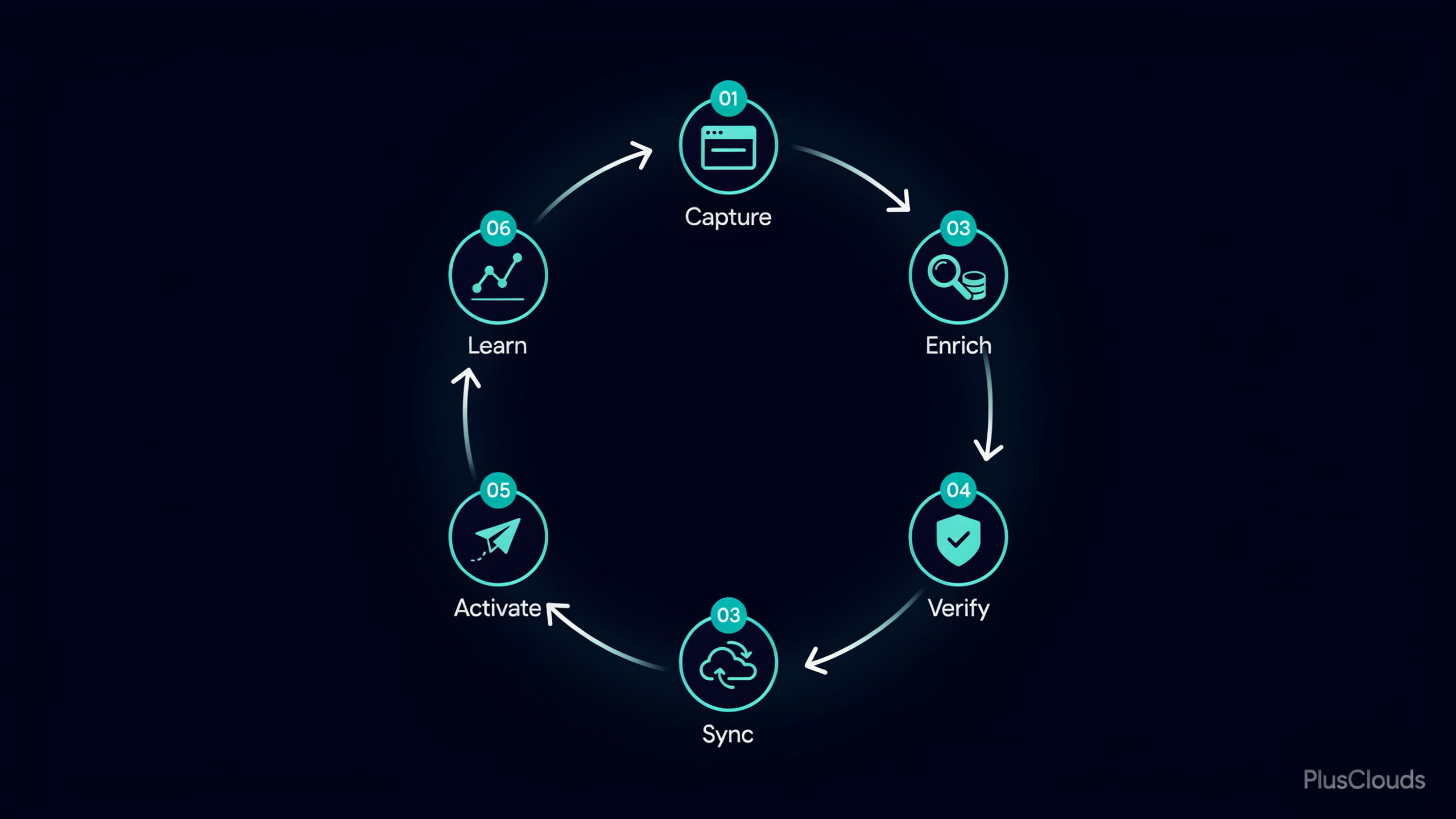
Now assemble the pieces. The full cookieless lead generation loop, end to end:
- Capture. Website visitor identification resolves anonymous traffic to company level. Event and email systems log engagement. CRM records sit as the outcome ledger.
- Enrich. First-party signals flow into LeadOcean, whose AI Match Engine expands your outcome-labelled account set into a lookalike target list across 1.8 billion company records, then layers live buying-signal detection on top.
- Verify. Matched accounts resolve to verified decision-maker contacts, so your sequences land with people who can actually buy.
- Sync. The HubSpot or Salesforce integration pushes enriched leads into your CRM with signal metadata and match scores, and pulls outcome changes back nightly.
- Activate. Eaglet triggers signal-matched sequences, personalises from first-party context, and logs every reply and engagement event back to the CRM.
- Learn. Quarterly backtests reweight your signal scores, and refreshed closed-won data retrains the match engine. The loop gets sharper every cycle.
The compounding effect is the real product. By the third or fourth cycle, your targeting is built from evidence your competitors cannot buy, your sequences reference behaviour only your properties generated, and your reply rates reflect relevance rather than volume. That is what "first-party data as a prospecting engine" means in practice: not a privacy compliance posture, but a structural advantage that widens over time.
If you want to see how this loop runs against your current stack, start with LeadOcean: connect your CRM, seed the Match Engine with your closed-won history, and add Eaglet when you are ready to activate the enriched leads with signal-triggered sequences. The data you already own is the hardest asset for any competitor to replicate. It is time it did some prospecting.