Your next big deal is probably being decided right now, and nobody on your sales team knows about it. The buying committee has already defined the problem, shortlisted vendors, and started comparing pricing pages. They will not fill out a form. They will not request a demo. By the time they do, the deal is mostly shaped, and whoever got there first set the terms.
This is the reality behind the shift to buying signals in B2B sales. Research consistently shows that buyers complete the majority of their journey, often 60 to 70 percent, before ever talking to sales. In 2026, the teams winning outbound are not the ones sending the most emails. They are the ones who see intent forming weeks before a prospect raises a hand, and act on it while the window is still open.
Key takeaways
- A buying signal is any observable data point (hiring spikes, funding rounds, leadership changes, tech stack changes, third-party intent surges) indicating an account is actively in-market.
- Traditional lead scoring only sees behavior inside your own funnel; signal-based targeting starts from buying timing itself.
- AI prospecting platforms detect signal patterns across 1.8B+ companies, turning a research problem into a ranked, intent-scored account list.
- Signals have a half-life. Teams that convert detected intent into revenue make first touch within roughly 48 hours.
- Integration with your CRM (HubSpot or Salesforce) is what turns signal detection from a dashboard into booked meetings.
Table of Contents
- What Are Buying Signals and Why They've Replaced Traditional Lead Scoring
- The Seven Types of Buying Signals That Matter in 2026
- How AI Detects Buying Signals Across 1.8B+ Companies
- Buying Signals vs. Intent Data: What's the Difference?
- From Signal to Outreach: Turning Detected Intent into a Booked Meeting
- Integrating Signal Detection with HubSpot and Salesforce
- Common Mistakes Teams Make When Acting on Buying Signals
- How to Get Started with AI-Powered Signal Detection
What Are Buying Signals and Why They've Replaced Traditional Lead Scoring
A buying signal is any observable behavior or data point that suggests a company is actively moving toward a purchase. A hiring spike for a specific role, a spike in review-site traffic, a leadership change, a technology installed or ripped out, funding announced last week. Individually, each is a hint. Together, they form a pattern that says this account is in-market right now.
Traditional lead scoring was built for a different era. It scored leads based on who they were (title, company size, industry) and what they did on your own properties (opened an email, visited a pricing page, downloaded a whitepaper). The problem is obvious in hindsight: it only saw the slice of buyer behavior that happened inside your funnel. Everything else, the research on third-party sites, the conversations in communities, the competitor comparisons, was invisible.
That invisible portion is exactly where modern buyers live. Industry analysis of 2026 lead generation trends points to the same conclusion from multiple directions: B2B tech buying has become a timing problem, not a volume problem, and the teams that win are those who detect timing early rather than those who blast the widest list (MarketScale).
Signal-based targeting flips the model. Instead of scoring static attributes and hoping timing works out, you start from timing itself. The question changes from "who fits our ICP?" to "who fits our ICP and is showing signs of buying this quarter?" That second question produces far shorter, far hotter lists.
The Seven Types of Buying Signals That Matter in 2026
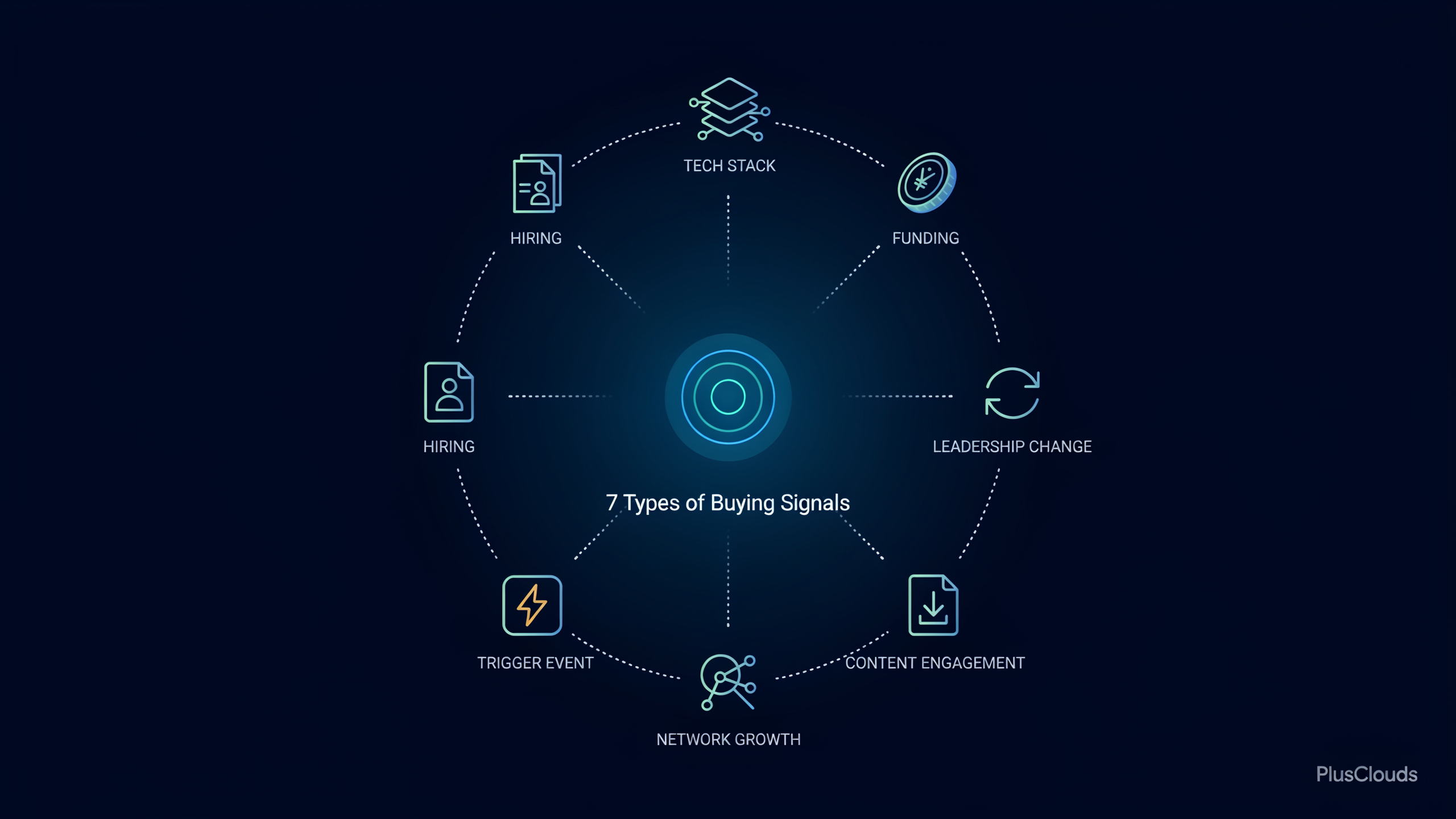
Not all signals carry equal weight. These seven categories are the ones worth building your outbound motion around:
- Hiring signals. A company posting five SDR roles is about to invest in outbound. A company hiring its first data engineer is building data infrastructure. Job postings are public, dated, and refresh daily, which makes them one of the most reliable free signal sources available.
- Technology change signals. New tool adoption or removal from a company's stack. If you sell a complement to a tool they just adopted, that's an opening. If they removed a competitor's product, that's a fire alarm.
- Funding and financial signals. Fresh funding rounds, new executives with budgets, IPO filings, or expansion announcements. A Series B company with a new VP of Sales has money and a mandate.
- Leadership change signals. New executives rewrite their tech stack within the first 90 days. This is one of the most actionable windows in B2B sales.
- Content and engagement signals. Downloads, webinar attendance, pricing page visits, repeat visits to comparison content. First-party, but only visible if you've instrumented your site properly.
- Third-party intent signals. Surge in topic-level research across review sites like G2 and industry publications, and content networks. This is where much of the anonymous 60 to 70 percent of the journey happens.
- Trigger event signals. Mergers, compliance deadlines, regulatory changes, outages, leadership restructuring. These create urgent problems that need solving on a schedule.
The strongest signal is rarely any single one of these. It's a combination: a funded company, with a new leader, hiring for roles related to your category, showing topic-level research surges. That's not a lead. That's a countdown timer.
How AI Detects Buying Signals Across 1.8B+ Companies
The scale is the problem. Signals exist across billions of web pages, job boards, tech-stack databases, review platforms, and news sources. No human team can monitor even a fraction of one market, let alone every company that could ever fit your ideal customer profile.
This is where AI prospecting changes the economics. Modern sales intelligence systems continuously crawl and normalize data across company registries, job postings, web technologies, and public financial data, then apply pattern recognition to distinguish noise from genuine intent. A spike in job postings alone might mean nothing. A spike in job postings plus a leadership change plus a research surge on topics adjacent to your category is a pattern worth acting on.
This is precisely the problem LeadOcean by PlusClouds was built for. It searches across more than 1.8 billion companies, applies an AI Match Engine to surface accounts that fit your ICP, and layers buying-signal detection on top so you're not just finding companies that could buy, but companies that are showing signs of buying now. Every contact is verified, which matters more than it sounds: signal-based targeting is worthless if the decision-maker data underneath it is stale.
The practical effect is a shift in how SDR teams spend their day. Instead of researching 100 accounts and guessing which 10 are warm, they open a list that's already ranked by intent and start with the top of it. Industry observers tracking AI-driven lead generation expect this to become the default operating model, not a competitive edge (RankFirms, Gravitas).
Buying Signals vs. Intent Data: What's the Difference?
The terms get used interchangeably, and that's a mistake worth clearing up, because they play different roles in a modern sales intelligence stack.
Intent data is the raw material. It's evidence of research activity: topic searches, content consumption, review-site visits. It tells you what a company is researching. It comes in two flavors:
- First-party intent: behavior on your own website and content. You own it, it's precise, but it only captures people who already found you.
- Third-party intent: research activity across the wider web, aggregated by intent providers like Bombora or 6sense. It captures the anonymous majority of the journey, but it's probabilistic and topic-level, not account-specific in every case.
Buying signals are the interpretation layer. A signal is a detected pattern, often combining intent data with firmographics, technographics, hiring data, and trigger events, that has been scored as meaning this account is likely in-market. Signals can exist without traditional intent data (a leadership change is a signal, not intent), and intent data without context is just noise.
The distinction matters operationally. Intent data answers "what are they researching?" Buying signals answer "should my SDR call them today?" If you want to go deeper on building the raw-data layer yourself, we've covered how to construct a first-party intent stack that feeds directly into LeadOcean, from anonymous website visitor to verified decision-maker in one workflow.
From Signal to Outreach: Turning Detected Intent into a Booked Meeting
Detection is only half the job. A signal that sits in a dashboard for a week is a signal your competitor will eventually monetize. The teams that convert signals into revenue share three habits:
They triage by urgency, not alphabetically. Trigger events and leadership changes decay fast. Hiring signals decay slowly. Your outreach queue should reflect that.
They personalize around the signal, not the company. "I saw you're scaling your RevOps team" outperforms "I saw you're a growing company" every time. The signal is the reason the message exists. If your first line could be sent to anyone, you've wasted the signal.
They move fast. There's a real activation window after a signal fires, and it's shorter than most teams think. We've written in detail about the 48-hour activation window and how to turn a buying signal into a booked meeting before your competitor even notices the account went warm.
Once the sequence starts, the mechanics matter less than the timing and relevance. If you need templates for the outreach itself, our battle-tested B2B email templates cover the message side of the equation.
Integrating Signal Detection with HubSpot and Salesforce
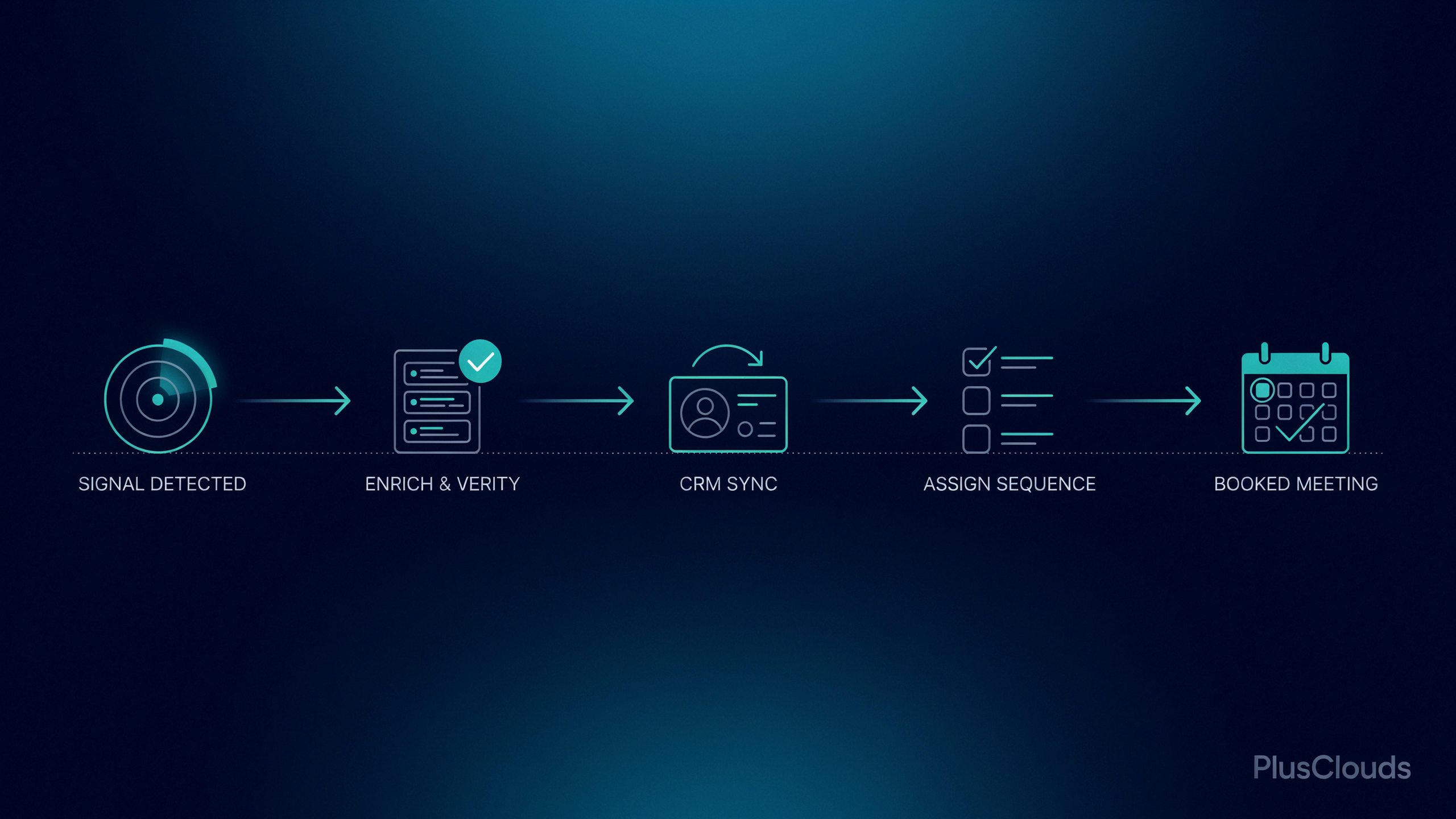
Signal detection that lives outside your CRM creates a second brain problem: your reps work in Salesforce or HubSpot, and anything that isn't there gets ignored. Integration is not optional.
A working signal-to-CRM pipeline looks like this:
- Signal detection fires on an account (hiring spike + leadership change, scored above threshold).
- The account and the right decision-maker contacts are enriched and verified.
- The account is created or updated in your CRM with the signal type, timestamp, and score attached.
- A task or sequence is assigned to the owning rep with a recommended first-touch angle based on the signal.
- Engagement is logged back so signal scores can be tuned over time.
LeadOcean integrates with both HubSpot and Salesforce natively, so detected signals and verified contacts flow into your existing pipeline without manual CSV rituals. For teams running coordinated multi-channel sequences, pairing signal detection with Eaglet, PlusClouds's sales-intelligence and outreach automation platform, closes the loop: signals trigger sequences across email, LinkedIn, and phone automatically, with Eaglet working standalone or as a LeadOcean add-on depending on how your stack is shaped.
We've broken down the full wiring of that combination in our guide to building an omnichannel outreach engine with LeadOcean and Eaglet, including how to sequence channels so reply rates multiply rather than cannibalize.
Common Mistakes Teams Make When Acting on Buying Signals
Signal-based targeting fails in predictable ways. Here are the four we see most often:
Treating every signal as equal. A single job posting is not a buying signal, it's a data point. Teams that react to everything end up right back at volume-based outreach with extra steps. Set thresholds. Score combinations. Ignore the noise.
Acting on stale signals. A funding round from eight months ago is background information, not a trigger. Signal freshness has a half-life, and outreach built on expired signals reads as out of touch, which is worse than no outreach at all.
Personalizing on the wrong thing. Mentioning the signal is table stakes. Connecting the signal to a problem the signal implies is what gets replies. "Congrats on the Series B" is filler. "Post-Series B teams usually discover their outbound can't scale past 200 accounts a month, here's how others fixed that" is a conversation.
Measuring the wrong outcome. If you judge signal-based outreach by volume metrics (emails sent, accounts touched), you'll drift back to volume behavior. Judge it by meetings booked per signal acted on, and time-to-first-touch after detection.
How to Get Started with AI-Powered Signal Detection
You don't need a six-month platform migration to start. A pragmatic rollout looks like this:
- Define your ICP precisely. Firmographics, technographics, and the problems you solve. Signal detection is only as good as the fit criteria underneath it. Our guide to the ICP-to-pipeline flywheel covers how firmographic filters, buying signals, and AI matching work together.
- Pick two or three signal types to start. Hiring signals and leadership changes are the easiest to validate because they're public, dated, and unambiguous. Add third-party intent once the basics work.
- Set a response SLA. Decide, as a team, that any account above your signal threshold gets first touch within 48 hours. This single policy separates signal-led teams from signal-collecting teams.
- Wire detection into your CRM. Signals should appear where your reps already work, with the context attached.
- Measure signal-to-meeting conversion. Iterate on thresholds and messaging based on which signals actually produce conversations.
Most teams that follow this sequence see the effect within one quarter: fewer emails sent, more meetings booked, and SDR time shifted from research to conversation. The broader industry consensus for 2026 is that this is where B2B lead generation is heading regardless (MarketBoats, DW Media), so the question is less whether to adopt signal-based targeting and more whether you do it before or after your competitors.
If you want to see what this looks like with real data, explore LeadOcean and watch the AI Match Engine surface in-market accounts from a database of 1.8 billion companies, with verified decision-maker contacts and buying signals attached. Pair it with Eaglet for automated multi-channel outreach, and your team goes from detecting a signal to a booked meeting while the window is still open. The buyers are already moving. The only question is who sees them first.